Arbitrage Funds Explained: Debt-Like Stability with Equity Taxation. Are They Worth It?
When navigating the financial markets, Indian investors often face a frustrating dilemma: how do you park your short-term capital without taking on massive stock market risk, while also avoiding the punishing taxation of traditional debt instruments?
For decades, conservative investors relied heavily on standard fixed deposits or short-duration debt funds. However, with recent changes to debt fund taxation, the search for a tax-efficient, low-volatility parking spot has intensified. This is exactly why getting arbitrage funds explained has become essential for modern investors.
These unique financial products bridge a critical gap. They aim to provide the stable, low-volatility experience of a debt fund while legally qualifying for the highly favorable tax treatment of an equity fund. But are they truly the perfect solution, or are there hidden risks beneath the surface?
If you have been asking what is an arbitrage fund, or debating an arbitrage fund vs liquid fund for your portfolio, you require a clear, objective analysis. In this deep dive, we will get arbitrage funds explained from the ground up. We will explore how do arbitrage funds work, decode the nuances of arbitrage fund taxation India, analyze the arbitrage fund STT impact 2026, and help you determine exactly where these tools belong in your financial journey.
What is an Arbitrage Fund?
To have arbitrage funds explained properly, we first need to look at their regulatory classification. Under the Securities and Exchange Board of India (SEBI) mutual fund categorization rules, an arbitrage fund is classified as a hybrid mutual fund.
By mandate, these funds must invest a minimum of 65% of their total assets in domestic equities and equity-related instruments to maintain their status as equity funds for tax purposes. The remainder is invested in safe debt instruments or kept as cash.
However, unlike a standard Flexi-Cap or Large-Cap fund, an arbitrage fund does not take a directional bet on the stock market. The fund manager does not buy a stock hoping its price goes up over the next five years. Instead, they exploit the price difference of the exact same asset across two different markets.
The Mechanics: How Do Arbitrage Funds Work?
Understanding exactly how do arbitrage funds work requires a brief look at the stock market structure. There is the "cash market" (where you buy stocks today) and the "futures market" (where you agree to buy or sell stocks at a specific price on a future date).
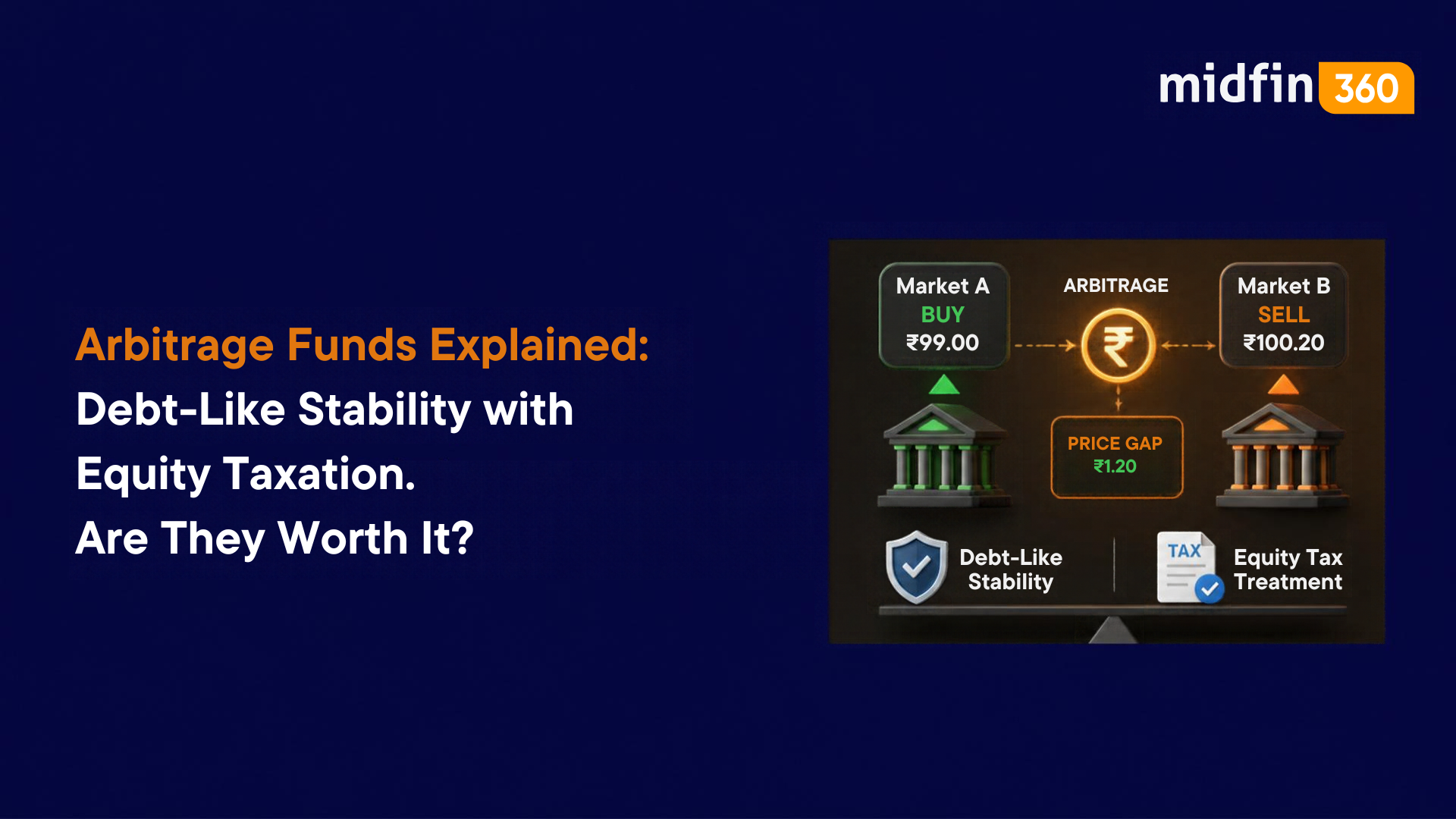
Arbitrage is the practice of simultaneously buying and selling an asset in different markets to profit from tiny differences in the asset's price.
Here is a simplified real-world example:
- The Buy: The fund manager sees that Reliance Industries is trading at ₹2,500 in the cash market.
- The Sell: Simultaneously, they see that the Reliance futures contract (expiring at the end of the month) is trading at ₹2,520 in the derivatives market.
- The Lock-in: The manager instantly buys the stock in the cash market for ₹2,500 and sells the futures contract for ₹2,520.
- The Result: By doing this simultaneously, the manager completely hedges the position. Regardless of whether the market crashes or soars by the end of the month, the fund has locked in a guaranteed ₹20 profit (known as the "spread") before transaction costs.
Because they execute thousands of these tiny trades constantly, these funds naturally have an extremely high turnover. We explain why a 400% to 500% turnover is completely normal for this specific category in our guide on understanding portfolio turnover ratio (PTR) and its impact on returns. If terms like futures, derivatives, or NAV are unfamiliar to you, we recommend keeping our comprehensive mutual fund jargon buster open as a reference.
Arbitrage Fund Taxation India: The Real Game Changer
The primary reason financial advisors want arbitrage funds explained to their clients is taxation. Because these funds hold over 65% in equities (even though they are completely hedged), the Income Tax Department of India treats them as pure equity funds.
When evaluating arbitrage fund vs debt fund tax, the difference is staggering following the recent tax regulation updates:
- Debt Funds: For any investment made after April 1, 2023, gains from debt mutual funds are added to your overall income and taxed at your applicable income tax slab rate (which could be up to 30%), regardless of how long you hold them.
- Arbitrage Funds (Equity Taxation):
- Short-Term Capital Gains (STCG): If you sell before 12 months, the profit is taxed at a flat 20%.
- Long-Term Capital Gains (LTCG): This is the magic number. If you are wondering how long to hold arbitrage fund for LTCG, the answer is more than 12 months. If held for over a year, gains exceeding ₹1.25 lakh in a financial year are taxed at just 12.5%.
(Disclaimer: Tax laws are subject to change. Always consult your Chartered Accountant to verify the exact implications for your specific tax bracket. You can track critical dates and filing deadlines using our mutual fund capital gains tax calendar.)
Arbitrage Fund vs Liquid Fund for Short-Term Parking
A frequent debate among investors looking for a safe parking spot is the arbitrage fund vs liquid fund comparison.
A liquid fund invests in high-quality debt instruments maturing in up to 91 days. To see how these debt vehicles form the bedrock of your safety net, read our guide on how to build an emergency fund with liquid funds.
- Predictability: Liquid funds are generally more predictable in their daily returns. Arbitrage funds can be slightly volatile in the very short term (daily or weekly) depending on how spreads widen or narrow in the market.
- Tax Efficiency: If you are in the 30% tax bracket and holding the money for more than a year, arbitrage funds mathematically destroy liquid funds in post-tax returns due to the 12.5% LTCG rate versus the 30% slab rate.
- The Verdict: If you need the money for a true emergency within the next 3 to 6 months, a liquid fund is superior. If you are parking cash for 12 to 18 months awaiting a better investment opportunity, an arbitrage fund is generally the smarter choice.
To understand where these specific categories sit on the risk spectrum relative to your broader portfolio, review our breakdown on equity, debt, hybrid: choosing the right fund type.
Is Arbitrage Fund Safe? Understanding the Risks
While we often associate these funds with debt-like stability, referring to them as completely "safe" or "risk-free" is misleading. When asking "is arbitrage fund safe?", you must understand the nuanced risks:
- Spread Risk: An arbitrage fund's return is entirely dependent on the availability of profitable "spreads" (price differences) between the cash and futures markets. In a flat or bearish stock market, these spreads can dry up completely, leading to very low returns for that period.
- The Arbitrage Fund STT Impact 2026: Recent Union Budgets have incrementally raised the Securities Transaction Tax (STT) on the futures and options (F&O) segment. Because arbitrage funds rely entirely on trading in these derivative markets, higher STT directly increases their transaction costs, which mathematically squeezes the available profit spreads. We discuss this specific tax nuance deeply in our guide on how to choose tax-efficient funds for your wealth goals.
- No Guaranteed Capital Protection: Unlike a bank fixed deposit, mutual funds do not guarantee your principal.
Arbitrage Fund Returns vs FD: Setting Expectations
Investors often compare these funds to traditional banking instruments. In an arbitrage fund returns vs FD analysis, the core difference is certainty.
A bank Fixed Deposit offers a locked-in, guaranteed interest rate, but the interest is fully taxable at your income slab rate every single year. Arbitrage funds do not offer guaranteed returns. Their returns fluctuate with market volatility. However, if an FD offers 7% (fully taxable) and an arbitrage fund generates 6.5% (taxed at 12.5% LTCG after a year), the arbitrage fund will often leave a High Net Worth Individual (HNI) with more money in their pocket.
It is also important to note that neither of these instruments is designed for massive wealth creation. If your goal is to generate high, real returns over decades, you must rely on pure equity funds. You can explore the data behind this in our companion piece: can mutual funds beat inflation?.
How to Utilize Them: Exit Loads and Portfolio Strategy
If you decide to use an arbitrage fund for short-term parking, you must be aware of the friction costs of entering and exiting.
Because fund managers need time to execute these complex trades, most AMCs impose an arbitrage fund exit load. This exit load (typically 0.25% to 0.50%) is usually levied if you withdraw your money within 15 to 30 days of investing. Always plan to hold the fund beyond this immediate lock-in period to avoid unnecessary penalties. You can understand how these fees impact your capital by reading our exit loads and lock-in periods mutual funds guide.
Strategically, these funds are excellent for systematic deployment. If you have a large lump sum, you can park it in an arbitrage fund and run a Systematic Transfer Plan (STP) into an aggressive equity fund over 12 months. If you are moving capital to manage your tax brackets, our guide on how to switch funds without losing tax benefits provides the exact structural roadmap.
Furthermore, for retirees drawing down their wealth, arbitrage funds serve as a highly tax-efficient component of "Bucket 1" (the immediate cash flow bucket), which we detail in our mutual funds for retirement safe withdrawal plan guide.
The midfin360 Advantage for Tactical Asset Allocation
Having arbitrage funds explained reveals that they are a highly specialized tactical tool, not a "buy and forget" core asset. Navigating changing STT rules, monitoring narrowing market spreads, and managing your capital gains tax liabilities requires deep expertise.
This is why midfin360, an AMFI-registered distributor (ARN-306591), believes that DIY investing often falls short for tactical allocation. We offer access exclusively to regular mutual fund plans because they inherently include the dedicated support of a professional mutual fund distributor.
When you manage your portfolio through our platform, you aren't just looking at isolated fund returns. Our Relationship Managers help you conduct holistic asset allocation, ensuring you utilize arbitrage funds efficiently for parking, without confusing them for your long-term growth engines. By aligning your tactical moves with your broader life goals, we ensure your wealth creation journey remains resilient against market shocks and tax friction.
Conclusion
Getting arbitrage funds explained unlocks a highly sophisticated tool for the modern Indian investor. By brilliantly marrying the low-volatility characteristics of debt with the highly favorable taxation of equity, these funds offer a compelling solution for short-to-medium-term cash parking.
However, they are not a magic bullet. Understanding the mechanics of how do arbitrage funds work, the impact of rising transaction costs (STT), and the absolute necessity of holding them for the right duration (over 12 months for LTCG) is critical to realizing their benefits. Whether you are using an arbitrage fund for short-term parking before deploying an STP, or managing your retirement cash flow, they require tactical precision.
You don't have to navigate these tax-efficient strategies in the dark. Partnering with a professional distributor ensures that every rupee in your portfolio is placed in the most optimal, tax-efficient vehicle for your specific time horizon.
Ready to optimize your cash management and build a truly resilient, tax-efficient portfolio?
Explore the midfin360 app and connect with our team to start your guided wealth journey today.
Frequently Asked Questions
Manage all from your mobile
Take charge of your finances seamlessly — only on the Midfin360 app