What Is an AIF (Alternative Investment Fund)? Categories, Minimum Investment & Who Should Invest
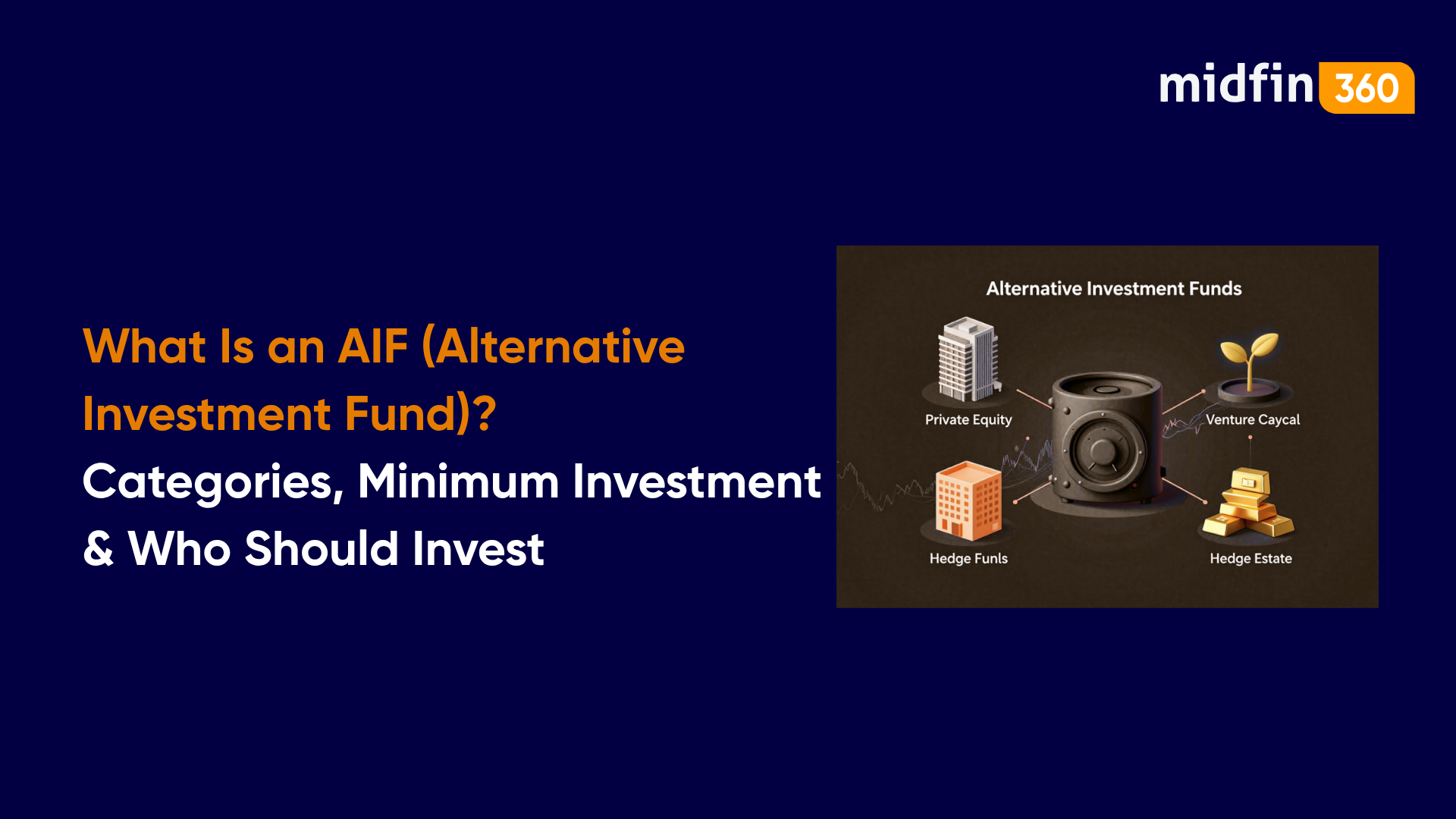
In the early stages of wealth creation, the financial formula is relatively straightforward: build an emergency fund, secure a solid term insurance policy, and start a Systematic Investment Plan (SIP) in a diversified portfolio of mutual funds.
However, as your corpus crosses the multi-crore mark and you transition into the High Net Worth Individual (HNI) bracket, your investment needs evolve. You might begin seeking non-correlated returns—investments that do not simply move up and down with the standard stock market index. You might want access to private startups before they go public, complex hedge-fund strategies, or distressed real estate debt.
Standard retail mutual funds are strictly regulated by the Securities and Exchange Board of India (SEBI) to prevent them from taking on these high-risk, illiquid exposures. To access these specialized opportunities, you must look toward a different financial vehicle.
If you are an affluent investor exploring premium products, this guide serves as part two of our HNI-products series (following our comprehensive guide on what is PMS portfolio management service). Below, we will decode exactly what is AIF alternative investment fund, break down the AIF categories I II III explained, clarify the strict AIF minimum investment India, and evaluate who can invest in AIF India.
What Is AIF Alternative Investment Fund?
An Alternative Investment Fund (AIF) is a privately pooled investment vehicle established or incorporated in India. Unlike a traditional mutual fund that collects money from millions of retail investors to buy publicly traded stocks or bonds, an AIF raises capital exclusively from sophisticated, high-net-worth investors (both Indian and foreign).
The fund manager then deploys this capital according to a highly specific, often complex, and less liquid investment policy. Because these strategies carry significantly higher risk and require specialized knowledge, they operate under the distinct SEBI (Alternative Investment Funds) Regulations, 2012.
Being a top-tier financial product, you will often see AIF discovery offered on premium wealth platforms. We discuss how these sophisticated instruments separate robust wealth-management ecosystems from basic transaction apps in our guide on what is AMFI registered and why it matters.
The Entry Barrier: AIF Minimum Investment India
The single most defining feature of an AIF is its massive entry barrier, designed intentionally by regulators to keep retail investors out of high-risk, illiquid assets.
According to SEBI AIF regulations, the AIF minimum investment India is strictly mandated at ₹1 Crore per investor.
- Exceptions: The only significant exception to this ₹1 crore rule is for the directors, employees, or fund managers of the AIF itself, for whom the minimum commitment is lowered to ₹25 lakh. There are also newer, highly specific regulations lowering the barrier for "Social Impact Funds" to ₹1,000, but these are niche philanthropic structures, not the wealth-creation AIFs targeted at HNIs.
- Maximum Investors: To maintain their "private pool" status, most AIF schemes are legally restricted to a maximum of 1,000 investors (except for Angel Funds, which are capped at 49).
If the ₹1 crore threshold is too high, or you prefer greater liquidity, you must explore alternative HNI structures. We clearly lay out where AIFs sit relative to other premium products in our detailed AIF vs PMS vs SIF breakdown: SIF vs mutual fund vs PMS: which one is right for you in 2026.
Decoding the Structure: AIF Categories I II III Explained
You cannot simply "invest in an AIF." You must choose a specific category, and each carries a vastly different risk and return profile. Getting the AIF categories I II III explained correctly is crucial, as they define exactly what the fund manager is allowed to do with your ₹1 crore.
Category I AIF: The Early Stage Backers
These funds invest in startups, early-stage ventures, social enterprises, SMEs, and infrastructure sectors. The government and regulators often view these funds as economically beneficial because they provide capital to sectors driving job creation and foundational growth. Consequently, Category I AIFs sometimes receive specific tax pass-through incentives.
- Sub-categories include: Venture Capital Funds (VCFs), SME Funds, Social Venture Funds, and Infrastructure Funds.
- Risk Profile: Extremely high. Investing in unlisted startups carries a massive risk of total capital loss if the businesses fail.
Category II AIF: The Private Equity & Debt Specialists
If a fund does not fall under Category I or III, and it does not undertake leverage (borrowing money to invest) other than to meet day-to-day operational requirements, it is a Category II AIF. This is the most popular AIF category in India.
- Sub-categories include: Private Equity (PE) Funds, Real Estate Funds, and Private Debt/Credit Funds.
- Risk Profile: High. These funds often buy stakes in mature but unlisted companies or provide high-yield debt to companies that cannot access traditional bank loans.
Category III AIF: The Complex Strategies (Hedge Funds)
These funds employ complex trading strategies, including aggressive asset allocation, arbitrage, margin trading, and derivatives. Unlike Categories I and II, Category III AIFs are legally permitted to use leverage (borrowing funds to amplify potential returns).
- Sub-categories include: Hedge Funds and PIPE (Private Investment in Public Equity) Funds.
- Risk Profile: Extremely high. The use of leverage means that while upside gains can be explosive, downside losses are mathematically magnified during market crashes.
Who Can Invest in AIF India?
The regulatory framework defining who can invest in AIF India is broad, provided the investor meets the ₹1 crore capital requirement and understands the inherent risks. Eligible investors include:
- Resident Indian individuals
- Non-Resident Indians (NRIs) and Overseas Citizens of India (OCIs)
- Hindu Undivided Families (HUFs)
- Corporate bodies, trusts, and partnership firms
- Foreign Portfolio Investors (FPIs)
It is critical to note that while AIFs offer the potential for massive, non-correlated returns that can easily outpace inflation, they are fundamentally illiquid. Most Category I and II AIFs are close-ended funds with lock-in periods extending from 3 to 10 years. If you need sudden access to your capital, an AIF is entirely the wrong vehicle. To understand the baseline necessity of inflation-beating returns for long-term wealth, read our companion piece: can mutual funds beat inflation?.
Navigating AIF Taxation India
Understanding AIF taxation India is notoriously complex because it varies drastically depending on the Category of the fund. We highly recommend consulting a chartered accountant before investing, but here is the general framework:
- Category I & II (Pass-Through Status): These categories generally enjoy "tax pass-through" status. This means the income generated by the fund (like capital gains or interest) is not taxed at the fund level. Instead, the income is "passed through" to the individual investor and taxed directly in their hands according to their specific income tax slab or applicable capital gains rates, just as if the investor had made the investment directly.
- Category III (No Pass-Through): Category III funds do not have pass-through status. The tax is paid directly at the fund level by the fund managers at the Maximum Marginal Rate (MMR). When the post-tax returns are finally distributed to the investors, they are generally exempt from further taxation in the investor's hands, though the high MMR can significantly drag down the gross CAGR (Compound Annual Growth Rate).
If you are confused by financial abbreviations like CAGR or XIRR, take a moment to review our mutual fund jargon buster.
The midfin360 Approach to Premium Products
The decision to allocate ₹1 crore into a single, highly illiquid Alternative Investment Fund requires meticulous financial planning and a deep understanding of your overall portfolio risk. It is not a decision to be made hastily on a DIY app.
At midfin360, an AMFI-registered distributor (ARN-306591), we believe that premium wealth creation requires a robust ecosystem of discovery and guidance. While our platform specializes in transacting regular plan mutual funds and live SIFs, we also offer an advanced discovery layer for AIFs (Category I, II, and III).
This means you can use the midfin360 platform to browse, learn about, and compare various AIF strategies from leading fund managers. When you are ready to evaluate if an AIF fits into your broader asset allocation, our dedicated Relationship Managers (RMs) are available to guide you through the complex onboarding, risk profiling, and regulatory compliance required for these sophisticated instruments.
Conclusion
Understanding what is AIF alternative investment fund is a critical milestone for any investor scaling into the HNI bracket. While the AIF minimum investment India of ₹1 crore serves as a steep gatekeeper, the access these funds provide to high-growth startups, private equity, and complex hedge-fund strategies is unparalleled in the traditional mutual fund space.
However, AIFs are not a replacement for a diversified core portfolio; they are high-octane satellite investments. They demand a high tolerance for risk, an acceptance of long lock-in periods, and a thorough understanding of AIF taxation India.
You do not have to navigate the complexities of Category I, II, or III funds alone. Partnering with a comprehensive wealth platform ensures that if you choose to lock your capital away, it is done strategically and in perfect alignment with your broader financial goals.
Ready to explore sophisticated wealth strategies tailored for your high-net-worth portfolio?
Frequently Asked Questions
Manage all from your mobile
Take charge of your finances seamlessly — only on the Midfin360 app