What Is an STP (Systematic Transfer Plan)? How to Move Lumpsum Money the Smart Way
Imagine receiving a substantial annual bonus, finalizing the sale of a property, or maturing a large fixed deposit. Suddenly, you have a massive lump sum of cash sitting in your bank account. You know that leaving it idle will cause it to lose value to inflation, and you want to invest it in equity mutual funds for long-term wealth creation.
But then, hesitation sets in. You look at the stock market, notice it is hovering near an all-time high, and think: What if I invest everything today, and the market crashes tomorrow?
This fear of market timing paralyzes many investors, causing them to hoard cash inefficiently. Fortunately, the mutual fund industry offers a brilliant structural solution to this exact dilemma. If you have been wondering how to invest lumpsum safely mutual fund, the answer lies in understanding what is STP systematic transfer plan.
Just as a monthly SIP automates your savings from your salary, an STP automates the deployment of a large lump sum into the market over time, drastically reducing the risk of bad timing. Before we dive deep, if terms like SIP, NAV, or SWP sound confusing, take a quick detour to our mutual fund jargon buster to build your baseline financial vocabulary.
In this comprehensive guide, we will break down exactly what is STP systematic transfer plan, analyze the STP vs lumpsum investment dilemma, clarify the STP vs SIP difference, explore the popular liquid fund to equity fund STP strategy, and decode the critical rules surrounding STP taxation India.
The Mechanics: What is STP Systematic Transfer Plan?
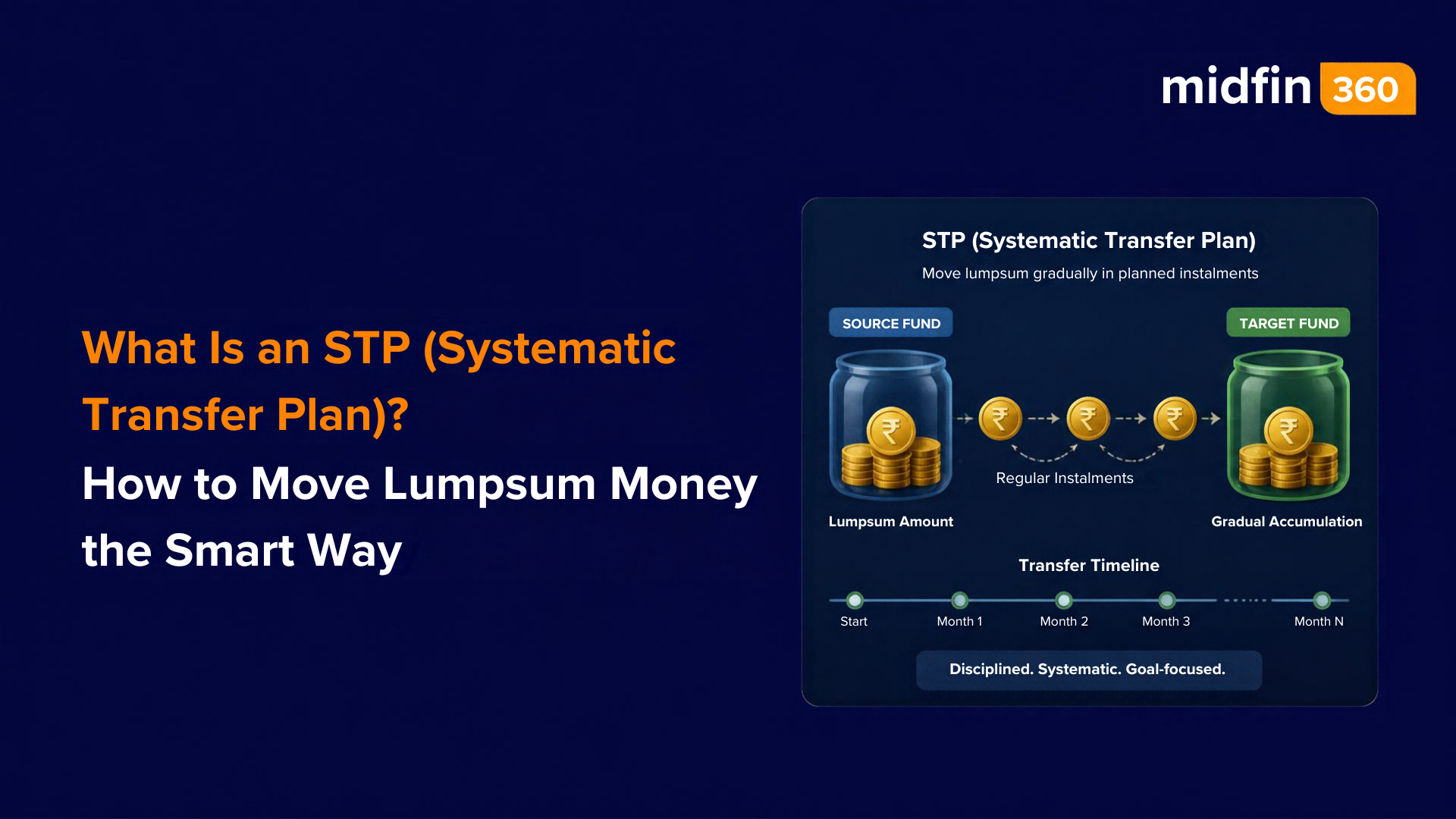
A Systematic Transfer Plan (STP) is an automated facility offered by an Asset Management Company (AMC) that allows you to shift a fixed amount of money from one mutual fund scheme (the source fund) to another mutual fund scheme (the target fund) at regular, pre-defined intervals.
To execute an STP, both the source fund and the target fund must belong to the exact same mutual fund house (AMC). You cannot run an STP from an HDFC mutual fund into an ICICI mutual fund.
By staggering your entry into the target fund, you benefit from rupee cost averaging. When the market is high, your scheduled transfer buys fewer units. When the market dips, that exact same transfer amount buys more units, lowering your average purchase cost over time without requiring you to manually track daily market movements.
STP vs Lumpsum Investment: The Honest Reality
When deciding how to invest lumpsum safely mutual fund, investors are often torn between deploying the capital all at once or staggering it via an STP. The STP vs lumpsum investment debate requires an honest look at market math versus human psychology.
- The Case for Lumpsum: Mathematically, in a consistently rising bull market, investing a lump sum on day one will outperform an STP. Because the market trends upward over the long term, deploying all your capital immediately gives it maximum time to compound.
- The Case for STP: The stock market is rarely a straight line. It is fraught with volatility, corrections, and sudden macroeconomic shocks. If you invest a lump sum on a Tuesday and the market corrects by 10% on a Wednesday, the psychological damage is massive. An STP acts as an emotional shock absorber. It minimizes the regret of buying at the absolute peak.
For most retail investors, the peace of mind provided by an STP heavily outweighs the potential marginal gains of perfectly timing a lump sum investment.
Understanding the STP vs SIP Difference (and SWP)
To build a robust portfolio, you must understand how different automated mandates work together.
- Systematic Investment Plan (SIP): Money moves from your bank savings account into a mutual fund. This is ideal for salaried professionals investing a portion of their monthly income.
- Systematic Transfer Plan (STP): Money moves from one mutual fund into another mutual fund (usually within the same AMC).
- Systematic Withdrawal Plan (SWP): Money moves from a mutual fund back into your bank account to provide a regular pension-like payout. To see how SWP fits into your golden years, read our detailed guide on how SWP explained helps create monthly income, which acts as the exact reverse mechanism of an STP.
All three of these tools are vital components of a mature financial plan, a concept we explore deeply in our breakdown of the ultimate investment ecosystem.
The Classic Strategy: Liquid Fund to Equity Fund STP
The most common and effective way to utilize this tool is the liquid fund to equity fund STP.
If you receive ₹10 Lakhs, leaving it in a standard bank savings account while running a standard SIP into an equity fund is inefficient, as the bank account yields very low interest.
Instead, the smart strategy involves:
- Parking the entire ₹10 Lakhs into a Liquid Fund or Ultra-Short Duration Debt Fund. These funds generally offer slightly better yields than savings accounts while maintaining high safety. You can learn more about deploying these secure instruments in our guide on how to build an emergency fund with liquid funds.
- Setting up an STP to transfer ₹1 Lakh every month from that Liquid Fund into your chosen aggressive Equity Fund over the next 10 months.
While the ₹10 Lakhs waits to be transferred, it continues to earn debt-fund returns, optimizing every single rupee of your capital.
Advanced Tactics: Flexi STP vs Fixed STP
As you dive deeper into what is STP systematic transfer plan, you will discover that AMCs offer different variations of this tool to suit different risk appetites.
1. Fixed STP
This is the standard, most popular variant. A pre-determined, fixed amount (e.g., ₹25,000) is transferred from the source fund to the target fund on a specific date every month, regardless of market conditions. It is simple, predictable, and highly effective for standard rupee cost averaging.
2. Flexi STP (or Capital Appreciation STP)
In a flexi STP vs fixed STP comparison, a Flexi STP is dynamic. The amount transferred fluctuates based on the performance of the target fund. If the equity market crashes, the STP automatically transfers a larger amount to buy more units at the discounted price. If the market is hitting all-time highs, it transfers a smaller amount.
Some AMCs also offer a "Capital Appreciation STP," where only the profit generated by the source liquid fund is transferred to the equity fund, leaving your original principal entirely safe in the debt fund.
The Crucial Reality Check: STP Taxation India
This is the single most misunderstood aspect of systematic transfers. When you automate an STP, it feels like a seamless internal shift. However, from a regulatory perspective, every single STP installment is treated as a redemption from the source fund and a fresh purchase into the target fund.
Because it is a redemption, STP taxation India rules apply to every transfer.
- Tax on the Source Fund: When you move money out of your Liquid Fund (the source), any profit made on that specific installment is subject to capital gains tax. According to the updated Income Tax Act rules, gains from debt funds (purchased after April 1, 2023) are added to your total income and taxed at your applicable income tax slab rate, regardless of the holding period.
- The Target Fund: The date the money lands in the equity target fund becomes the new date of purchase for those specific units when calculating future long-term or short-term equity capital gains.
It is vital to account for these rolling tax liabilities. We cover the tactical ways to manage tax during internal fund movements extensively in our guide on how to switch funds without losing tax benefits.
The midfin360 Advantage for Systematic Transfers
Understanding what is STP systematic transfer plan is only half the battle; executing it flawlessly requires a professional platform and expert guidance.
At midfin360 (AMFI-registered ARN-306591), we do not believe retail investors should navigate the complexities of lump-sum deployments and rolling tax liabilities on unguided DIY apps. We offer access exclusively to regular mutual fund plans because they inherently include the dedicated support of a professional mutual fund distributor.
When you have a significant lump sum to invest, our Relationship Managers help you map out the perfect liquid fund to equity fund STP timeline. We ensure your source fund matches your risk profile, calculate the potential tax friction of the transfers, and align the entire strategy with your ultimate life goals. As you transition through life stages—perhaps moving from accumulating wealth via STP to drawing it down in retirement—we are there to guide you. You can see how these tools shift over a lifetime in our safe withdrawal retirement guide.
Conclusion
Mastering exactly what is STP systematic transfer plan empowers you to take control of sudden wealth without falling prey to the anxiety of market timing.
By strategically parking your lump sum in a stable debt instrument and utilizing a liquid fund to equity fund STP, you ensure that your money is always working for you, safely navigating market volatility through disciplined rupee cost averaging. While STP taxation India adds a layer of calculation to the process, the emotional peace of mind and structured risk management it provides make it an indispensable tool for serious investors.
You do not have to map out these complex transfer strategies alone. Partnering with a professional distributor ensures that every automated transfer moves you closer to your ultimate financial freedom.
Ready to deploy your capital smartly and build a resilient, goal-oriented portfolio?
Explore the midfin360 app and see how our team can support your wealth journey today
Frequently Asked Questions
Manage all from your mobile
Take charge of your finances seamlessly — only on the Midfin360 app