What Is Tracking Error? Why Your Index Fund Doesn't Perfectly Match the Nifty 50
Passive investing has taken the Indian financial landscape by storm. Driven by the appeal of low costs and market-matching returns, millions of investors are utilizing Systematic Investment Plans (SIPs) to pour capital into funds mirroring major indices like the Nifty 50 or Sensex.
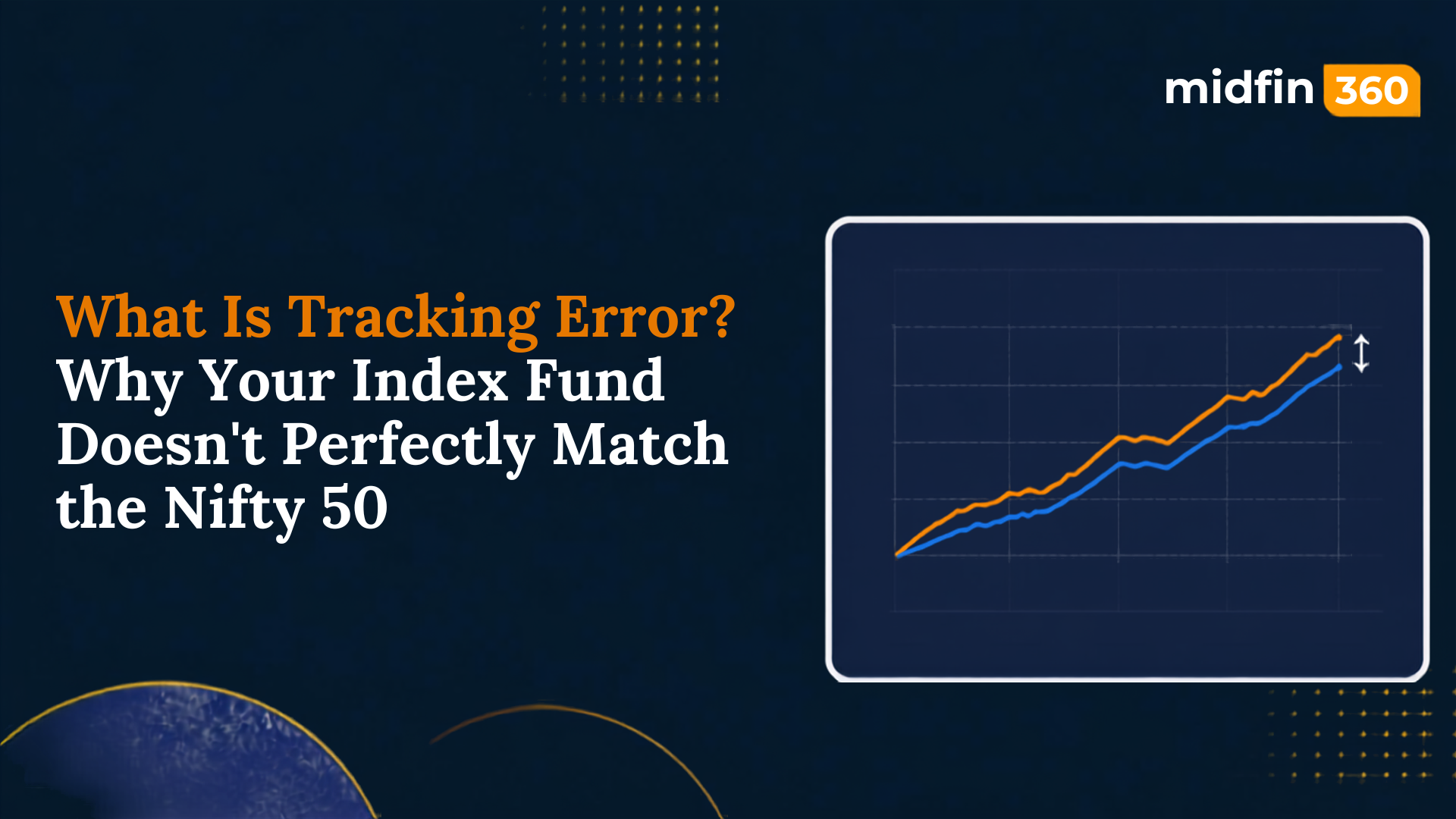
The promise of passive investing is straightforward: whatever the market does, your fund will do. However, when investors check their consolidated portfolio statements at the end of the year, they often notice a discrepancy. If the National Stock Exchange (NSE) benchmark Nifty 50 index grew by 15%, their specific Nifty 50 index fund might have only grown by 14.2%.
This invisible gap can cause confusion and frustration. To truly master passive investing and optimize your asset allocation, you must understand the mathematical mechanics working behind the scenes.
If you have been asking yourself what is tracking error in mutual funds and exactly why does index fund underperform Nifty 50, you are in the right place. In this detailed guide, we will decode this vital metric, explain the technical difference between tracking difference vs tracking error, compare tracking error index fund vs ETF, and provide a clear framework on a low tracking error fund how to choose for your portfolio.
The Illusion of a Perfect Match
An index mutual fund is structurally designed to replicate a specific benchmark index. The fund manager's job is not to pick winning stocks (generating alpha), but simply to buy the exact same stocks, in the exact same proportions, as the underlying index.
Because of this automated approach, these funds form the bedrock of many portfolios. We extensively cover the profound benefits of this strategy in our guide on building a low-cost portfolio using index funds in India. However, in the real world, a perfect 1:1 replication is mathematically impossible.
The deviation between the performance of the mutual fund and the performance of its underlying benchmark index is known broadly as tracking error. (If statistical metrics like this seem intimidating, we recommend keeping our mutual fund jargon buster handy to quickly build your financial vocabulary).
Tracking Difference vs Tracking Error: Getting Technical
Before diving into the causes, we must clarify a critical distinction that even seasoned investors often confuse: tracking difference vs tracking error.
- Tracking Difference: This is the absolute, cumulative gap in returns between the fund and the index over a specific period. If the index returned 10% in a year and your fund returned 9.2%, the tracking difference is an underperformance of 0.8%.
- Tracking Error: In strict statistical terms, tracking error is the standard deviation (volatility) of that tracking difference over time. It measures how consistently the fund matches the index on a daily basis.
A fund might have a low tracking error (meaning its daily deviations are highly consistent and predictable) but a high tracking difference (meaning it is consistently underperforming the index by a wide margin, usually due to high fees). Understanding these risk metrics is vital; you can learn more about measuring statistical risk in our deep dive on understanding Sharpe ratio, Alpha, and Beta.
The Hidden Causes: Why Does Index Fund Underperform Nifty 50?
When you ask what is tracking error in mutual funds, you are really asking about the friction costs of managing real money in a live market. Here are the primary culprits that cause your fund to deviate from the index:
1. The Inevitable Expense Ratio
An index is a theoretical mathematical model; it has no operational costs. A mutual fund, however, is a real-world product. The Asset Management Company (AMC) must pay for administrative operations, regulatory compliance mandated by the Securities and Exchange Board of India (SEBI), audit fees, and technology platforms.
These costs form the Total Expense Ratio (TER). If a fund charges a 0.20% expense ratio, the fund's return is mathematically guaranteed to trail the index by at least 0.20% annually. When evaluating tracking error vs expense ratio, the TER is the largest and most predictable driver of tracking difference.
2. Cash Drag (Liquidity Management)
Unlike a theoretical index, an open-ended mutual fund must process daily cash inflows (from SIPs and lump sums) and cash outflows (from investors redeeming units).
To meet daily redemption requests without being forced to sell stocks at a loss during a market crash, the fund manager must hold a small portion of the fund's assets in pure cash or highly liquid cash equivalents. This phenomenon is known as cash drag. In a rising bull market, the cash sitting idle in the fund does not earn equity returns, causing the fund to slightly underperform the fully-invested index.
3. Rebalancing Timing Lag
Indices periodically reconstitute. For example, if a company in the Nifty 50 loses significant market capitalization, the index provider will remove it and replace it with a growing company.
The index changes instantaneously on paper. However, the mutual fund manager must physically sell millions of shares of the exiting company and buy millions of shares of the new company in the open market. This takes time, incurs brokerage fees, and creates a "timing lag" where the fund's holdings briefly do not match the index, introducing tracking error.
4. Corporate Actions and Dividends
When a company issues dividends, the theoretical "Total Return Index" (TRI) assumes those dividends are instantly reinvested back into the index on the exact same day. In reality, the mutual fund receives the dividend cash in its bank account and takes time to physically deploy it back into the market, creating another layer of performance deviation.
Comparing Vehicles: Tracking Error Index Fund vs ETF
The debate between traditional index mutual funds and Exchange Traded Funds (ETFs) heavily features tracking error. If you are unfamiliar with how these products structurally differ, reading our comprehensive breakdown on what are index ETFs and how do they differ from index funds will clarify the mechanics.
In the tracking error index fund vs ETF comparison, ETFs historically exhibit a marginally lower tracking error. Why? Because ETFs trade on the stock exchange like regular shares, they do not have to manage the daily cash inflows and outflows of retail investors directly. Consequently, ETF managers do not suffer from the same level of "cash drag" that mutual fund managers do.
Furthermore, you must also consider layered products. When you invest in a Fund of Funds (FoF) that buys ETFs, the friction changes again. To understand how tracking error is inherited through these layered structures, refer to our analysis on ETF vs FoF: which is better for your wealth journey, which addresses this specific nuance in its FAQ section.
Actionable Strategy: Low Tracking Error Fund How to Choose
Now that you understand what is tracking error in mutual funds, how do you use this knowledge to select the right index fund? Chasing the lowest expense ratio is not enough; you must evaluate how efficiently the fund is managed.
For a broader perspective on assessing fund quality beyond passive vehicles, explore our guide on how to evaluate mutual fund performance India. Specifically for index funds, follow these steps:
- Check the Tracking Error Metric: Review the fund's monthly factsheet. Look for the stated tracking error (usually annualized). A lower number (e.g., 0.05% vs 0.15%) signifies that the fund manager is replicating the index with higher precision.
- Evaluate the AUM Size: Funds with a very small Asset Under Management (AUM) often struggle with high tracking errors because operational costs eat up a larger percentage of the fund, and large cash inflows disproportionately skew their rebalancing. Look for index funds with a robust, stable AUM.
- Analyze the Tracking Difference: Look at the fund's 3-year and 5-year trailing returns against the benchmark's TRI. The gap should be relatively close to the fund's stated expense ratio. If the gap is wildly larger than the TER, the manager is suffering from severe cash drag or execution inefficiencies.
- Factor in Taxation: Remember that index funds are treated as equity mutual funds under the Income Tax Act. Long-Term Capital Gains (LTCG) above ₹1.25 lakh are taxed at 12.5%. Efficiently managed funds with low tracking error ensure that more of your capital survives to face taxation, rather than being lost to internal friction costs.
The midfin360 Advantage in Portfolio Building
Understanding why does index fund underperform Nifty 50 highlights a crucial reality: even passive investing requires active, intelligent decision-making at the selection phase.
This is the core value proposition of midfin360 (AMFI-registered ARN-306591). While Direct plan platforms leave you to navigate factsheets and tracking error metrics entirely on your own, midfin360 believes in guided wealth creation. By offering Regular mutual fund plans, we provide you with a dedicated distributor relationship.
When you explore midfin360, our team helps you filter through dozens of seemingly identical index funds to identify the ones with the tightest tracking metrics and optimal liquidity. More importantly, we help you determine the correct allocation of passive index funds versus active Flexi-cap or thematic funds, ensuring your portfolio perfectly aligns with your specific risk profile and life goals.
Conclusion
Understanding what is tracking error in mutual funds transforms you from a passive participant into an informed investor. While index funds offer a brilliant, low-cost avenue for long-term wealth creation, they are not immune to the friction of the real-world financial markets.
By recognizing the impact of cash drag, expense ratios, and rebalancing lags, you can accurately evaluate why does index fund underperform Nifty 50 and make smarter selection choices. Remember, in the marathon of compounding, minimizing unnecessary friction costs is just as vital as maximizing returns. You do not have to navigate these metrics alone; partnering with an expert distributor ensures your passive investments are working as efficiently as mathematically possible.
Ready to build a highly efficient, goal-oriented portfolio with expert support?
Explore the midfin360 app and see how our team can support your wealth journey today.
Frequently Asked Questions
Manage all from your mobile
Take charge of your finances seamlessly — only on the Midfin360 app