Term Insurance vs Life Insurance: What's the Real Difference?
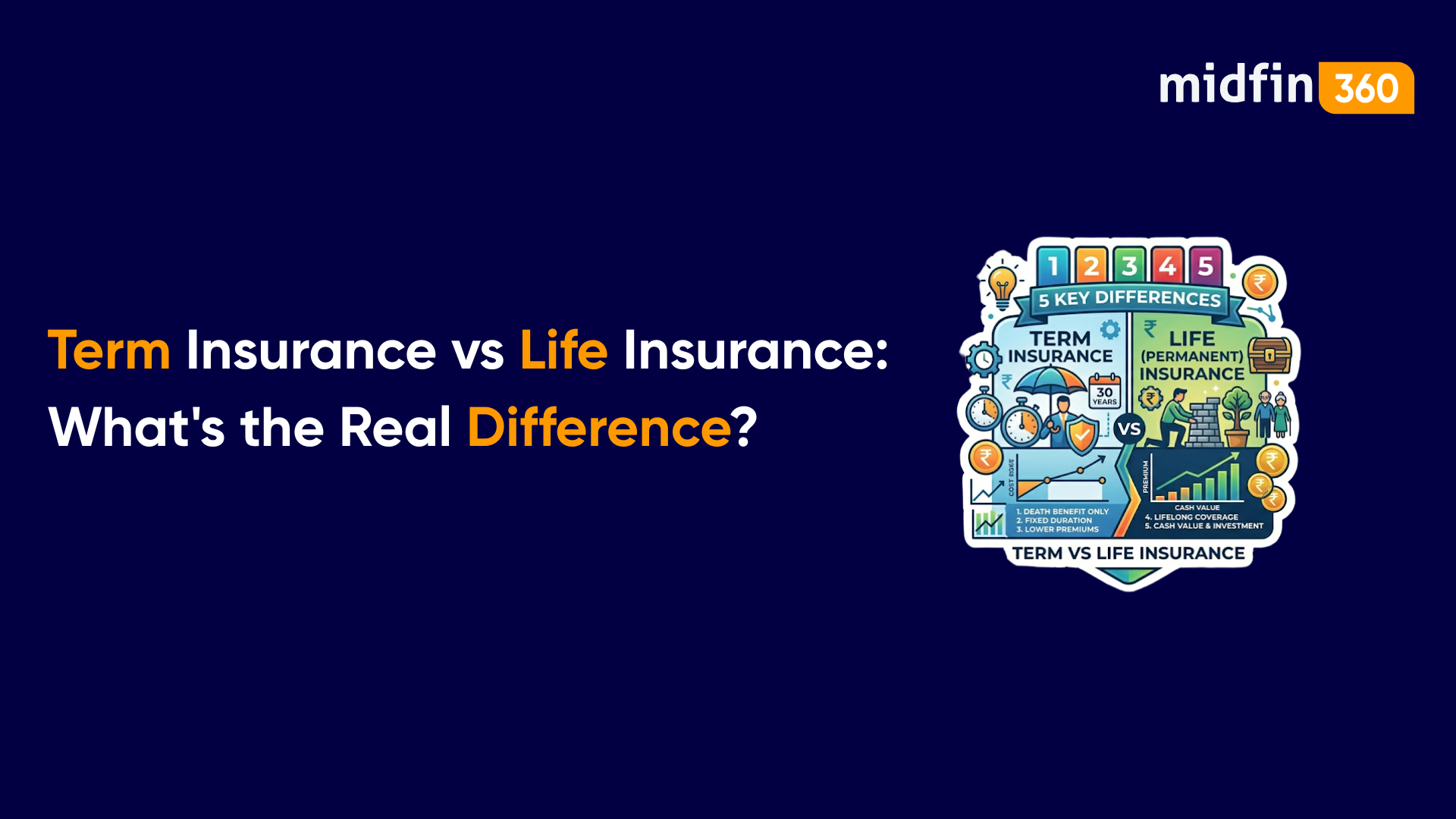
If you have ever sat down to plan your family's financial security, you have likely encountered a dizzying array of insurance products. Relatives suggest one policy, bank relationship managers push another, and online ads promote something completely different. At the heart of this confusion lies one fundamental question: what is the actual difference in the term insurance vs life insurance debate?
For decades, the traditional approach in India was to buy insurance policies that promised a lump sum payout at maturity. However, as financial literacy evolves in 2026, more investors are realizing that mixing insurance with investment is often a recipe for sub-optimal returns and inadequate life cover.
In this comprehensive guide, we will break down the crucial difference between term and life insurance. We will explore why separating your insurance from your investments is the golden rule of financial planning, and how once your family is protected, you can focus on genuine, long-term wealth creation through guided Systematic Investment Plans (SIPs) on midfin360.
What is Life Insurance? The Umbrella Concept
To understand the core differences, we first need to clarify the terminology. Life insurance is an umbrella term. It is a broad contract between an individual and an insurance company wherein the insurer promises to pay a designated beneficiary a sum of money upon the death of the insured person. This primary payout is known as the death benefit life cover.
However, over the years, insurance companies created various "flavors" of life insurance that combined this death benefit with a savings or investment component. When people ask for the best life insurance plan India, they are usually thinking of these traditional policies.
Common Types of Traditional Life Insurance
- Endowment Plans: These policies offer a death benefit if you pass away during the policy term, but they also offer an endowment plan maturity benefit if you survive the term. A portion of your premium goes toward life cover, while the rest is invested in low-risk debt instruments.
- Whole Life Insurance: As the name suggests, whole life insurance India provides coverage for your entire lifetime (typically up to age 99 or 100), rather than a specific term. It also accumulates a cash value over time.
- Money-Back Policies: A money-back policy India pays out a percentage of the sum assured at regular intervals during the policy tenure as a "survival benefit," with the remaining balance paid at maturity or death.
- Unit Linked Insurance Plans (ULIPs): A ULIP combines life insurance with market-linked investments (like equity or debt funds). You get a life cover, and the remainder of your premium is invested in the markets.
What is Term Insurance? The Pure Protection Plan
Now, let us look at the other side of the coin. Term insurance is actually a subtype of life insurance. It is the simplest, most fundamental form of life cover available.
A term plan is a pure protection plan. You pay a premium for a specific "term" (e.g., 20, 30, or 40 years). If you unfortunately pass away during this term, your nominees receive a massive death benefit. If you survive the term, the policy simply expires, and you get nothing back (unless you opted for a specific "return of premium" rider, which generally defeats the purpose of keeping costs low).
Because there is no investment or savings component involved, the insurer's risk is lower, which means the premiums are incredibly cheap for massive amounts of coverage. When looking at term insurance India 2026, the focus is entirely on securing the highest possible cover for the lowest possible premium, guided by the regulations of the Insurance Regulatory and Development Authority of India (IRDAI).
Term Insurance vs Life Insurance: Breaking Down the Differences
The true difference between term and life insurance (specifically traditional endowment or whole life plans) boils down to cost, coverage, and purpose. Let us explore the key comparisons.
1. Term Insurance vs Endowment Plan
This is the most common crossroads for investors. An endowment plan promises you a maturity benefit. It sounds appealing: "If nothing happens to me, at least I get my money back!"
However, the math tells a different story. Because the insurance company has to guarantee a return, they invest your premium very conservatively. Historically, traditional life insurance returns hover around 4% to 6%. This barely beats the inflation rate. Furthermore, because a large portion of your premium goes toward the investment, the actual life cover (sum assured) is usually very small—often inadequate to replace your income for your family.
A term plan, conversely, offers zero maturity benefit but provides a massive life cover for a fraction of the cost, ensuring true financial security for your dependents.
2. Term Plan vs Whole Life Insurance
A whole life policy covers you until you die, meaning a payout to your heirs is guaranteed. As a result, the premiums are significantly higher than term insurance.
The question to ask yourself is: do you need insurance when you are 85 years old? The purpose of life insurance is to replace your income if you die prematurely while you have financial dependents and liabilities (like a home loan). By the time you retire, your liabilities should ideally be zero, and your accumulated wealth should be self-sustaining. Therefore, a term plan that covers your working years is usually much more efficient than paying high premiums for a whole life policy.
3. ULIP vs Term Insurance
When comparing ULIP vs term insurance, we enter the territory of market-linked returns. ULIPs offer life cover and invest in equity markets. While they have improved over the years, they often come with complex fee structures, including mortality charges, fund management charges, and premium allocation charges.
A term plan keeps your insurance completely separate from the stock market. You pay a small fee for your term cover, leaving you with more capital to invest independently in more transparent, flexible vehicles like a regular mutual fund.
How Much Term Insurance Cover Do I Need?
If you decide that a pure protection plan is right for you, the next step is a proper sum assured life cover calculation. Buying an arbitrary cover amount (like ₹50 Lakhs) without assessing your family's actual needs is dangerous.
A standard, widely accepted rule of thumb is the 10 times annual income cover rule. If your current take-home salary is ₹15 Lakhs per year, your base term insurance cover should be at least ₹1.5 Crores.
However, a more comprehensive calculation involves:
- Adding up all your outstanding debts (home loans, car loans, personal loans).
- Calculating future major expenses (children's higher education, marriage).
- Estimating your family's monthly living expenses and adjusting for inflation over the years they will need support.
- Subtracting your current liquid savings and investments.
When calculating this, it is also vital to research the claim settlement ratio insurer metrics. A slightly higher premium is worth paying if the insurance company has a stellar, consistent track record of settling death claims quickly and without hassle. You can utilize any online term insurance premium calculator to estimate costs based on your age, lifestyle (smoking habits significantly impact premiums), and desired cover.
The Golden Rule: Insurance vs Investment Separation
The biggest takeaway from the term insurance vs life insurance debate is the principle of insurance vs investment separation.
Insurance is an expense meant to protect your family against a catastrophic financial loss. Investment is a strategic process of growing your money to achieve future goals. Mixing the two usually results in an expensive product that offers inadequate insurance and mediocre investment returns.
This leads us to the most powerful financial strategy you can adopt: buy term invest the rest India.
The "Buy Term, Invest the Rest" Strategy Explained
Let us look at a hypothetical comparison for a 30-year-old seeking a ₹1 Crore life cover.
- Scenario A (Traditional Endowment): To get a ₹1 Crore cover, the premium for an endowment plan could easily be ₹1,00,000 or more per year. The returns upon maturity will likely be around 5%.
- Scenario B (Buy Term, Invest the Rest): The same 30-year-old buys a ₹1 Crore pure term insurance plan for roughly ₹12,000 per year. They take the remaining ₹88,000 and invest it in a diversified equity mutual fund via an automated SIP.
Historically, diversified equity mutual funds have the potential to deliver inflation-beating Compound Annual Growth Rate (CAGR) returns significantly higher than traditional insurance plans over a 15 to 20-year horizon. By separating the two, you secure maximum protection for your family today, while building massive, transparent wealth for tomorrow.
Sorted Your Protection? Time to Grow Wealth with midfin360
Once you have secured a robust term insurance policy, your primary financial risk is covered. The next logical step is to execute the "invest the rest" portion of the strategy. This is exactly where midfin360 steps in as your trusted partner for wealth creation.
Many investors try to invest the rest by themselves on direct platforms, only to make emotional mistakes during market volatility or pick funds that don't align with their actual life goals. At midfin360, we operate exclusively as a B2C regular mutual fund platform. We believe that professional guidance is the key to sustained, stress-free wealth generation.
Here is how midfin360 helps you build your post-insurance wealth:
- Expert Distributor Guidance: Our platform connects you with registered professionals who help you craft a tailored asset allocation strategy. They ensure your investments match your risk profile, preventing you from taking on excessive equity mutual fund market risk.
- Goal-Based SIPs: We help you map your investments to real life goals—whether it is your child’s education or your own retirement. Setting up a NACH/e-NACH mandate ensures your long term SIP during market crash or boom remains uninterrupted, capturing the magic of compounding.
- Holistic Portfolio View: Track your Net Asset Value (NAV), monitor your XIRR, and review your entire family’s holdings through our seamless app interface.
- Beyond Equity: True diversification goes beyond mutual funds. midfin360 offers access to Fixed Deposits (FDs), the National Pension System (NPS) for retirement planning, and Specialised Investment Funds (SIFs).
- Tax Efficiency Made Easy: Navigating Long Term Capital Gains (LTCG) and STCG can be a headache. Our built-in capital gains reports simplify your tax filing under the purview of the Income Tax Department, and we guide you toward tax-saving ELSS funds under Section 80C.
By choosing regular mutual funds on midfin360 under the regulatory framework of the Securities and Exchange Board of India (SEBI), you ensure that your wealth is guided, monitored, and aligned with the future you envision.
Frequently Asked Questions (FAQs)
Is term insurance the same as life insurance? Term insurance is a specific type of life insurance. While "life insurance" is a broad category that includes plans with investment components (like endowment or whole life), term insurance is a "pure protection plan" that only pays out if the policyholder dies during the policy term, offering no maturity benefit.
Which is better: term insurance or life insurance? When asking which is better term insurance or life insurance, financial experts almost universally recommend term insurance for protection. It offers the highest cover for the lowest premium. Traditional life insurance policies often provide inadequate cover and offer returns that struggle to beat inflation.
Can term insurance be converted to life insurance? Some insurance companies offer a "convertible term plan," which allows you to convert your term insurance into a whole life or endowment policy at a later date without undergoing a fresh medical exam. However, this depends entirely on the specific terms and conditions of your insurer.
Why is term insurance cheaper than life insurance? Term insurance is cheaper because there is no investment or savings component, and therefore, no guaranteed maturity payout if you survive the term. The insurance company is only taking the risk of your mortality during a specific timeframe, which keeps the premiums exceptionally low.
How much term insurance cover do I need? A general rule is to secure a cover that is at least 10 to 15 times your annual income. However, a proper calculation should factor in your outstanding loans, future family goals (like children's education), and the monthly living expenses your dependents will need if you are no longer around.
Is term insurance enough or do I need life insurance too? For the vast majority of people, a robust term insurance policy paired with a disciplined investment strategy (like mutual fund SIPs) is more than enough. You do not need to mix traditional life insurance into your portfolio if your primary goal is financial protection and wealth creation.
What happens if I survive the term insurance period? If you survive the duration of a standard term insurance policy, the policy simply expires. You do not receive any money back. This is normal and expected; the premium you paid was the cost of protecting your family from financial ruin during your high-liability years.
Is endowment plan better than term insurance? No, from a purely financial planning perspective, an endowment plan is rarely better. While it offers a maturity benefit, the returns are typically very low, and the life cover provided is usually insufficient. The "buy term, invest the rest" approach is a mathematically superior wealth-building strategy.
Conclusion: Protect First, Prosper Next
The term insurance vs life insurance debate is easily resolved once you commit to separating your protection needs from your wealth creation goals. Understanding the difference between term and life insurance empowers you to reject high-cost, low-return traditional plans in favor of a massive, affordable pure protection plan.
Once your family's future is secured against the unexpected, your focus must shift to disciplined wealth generation. Don't let your "invest the rest" capital sit idle in savings accounts or get lost in confusing direct investing platforms.
Ready to start growing the wealth you've just protected? Download the midfin360 app today to set up your automated SIPs in regular mutual funds, track your portfolio’s XIRR, and let our registered distributors guide you toward achieving your family's long-term financial goals safely and systematically!
Disclaimer: Mutual Fund investments are subject to market risks, read all scheme related documents carefully. The information provided in this blog regarding insurance is for educational purposes only. midfin360 does not sell or distribute insurance products. The content does not constitute personalized financial or insurance advice. Past performance of mutual funds is not indicative of future returns. midfin360 is a AMFI-registered Mutual Fund Distributor.
Manage all from your mobile
Take charge of your finances seamlessly — only on the Midfin360 app