SEBI Makes Direct Plans the Default on AMC Platforms: What It Means for Your Regular Plan Investments
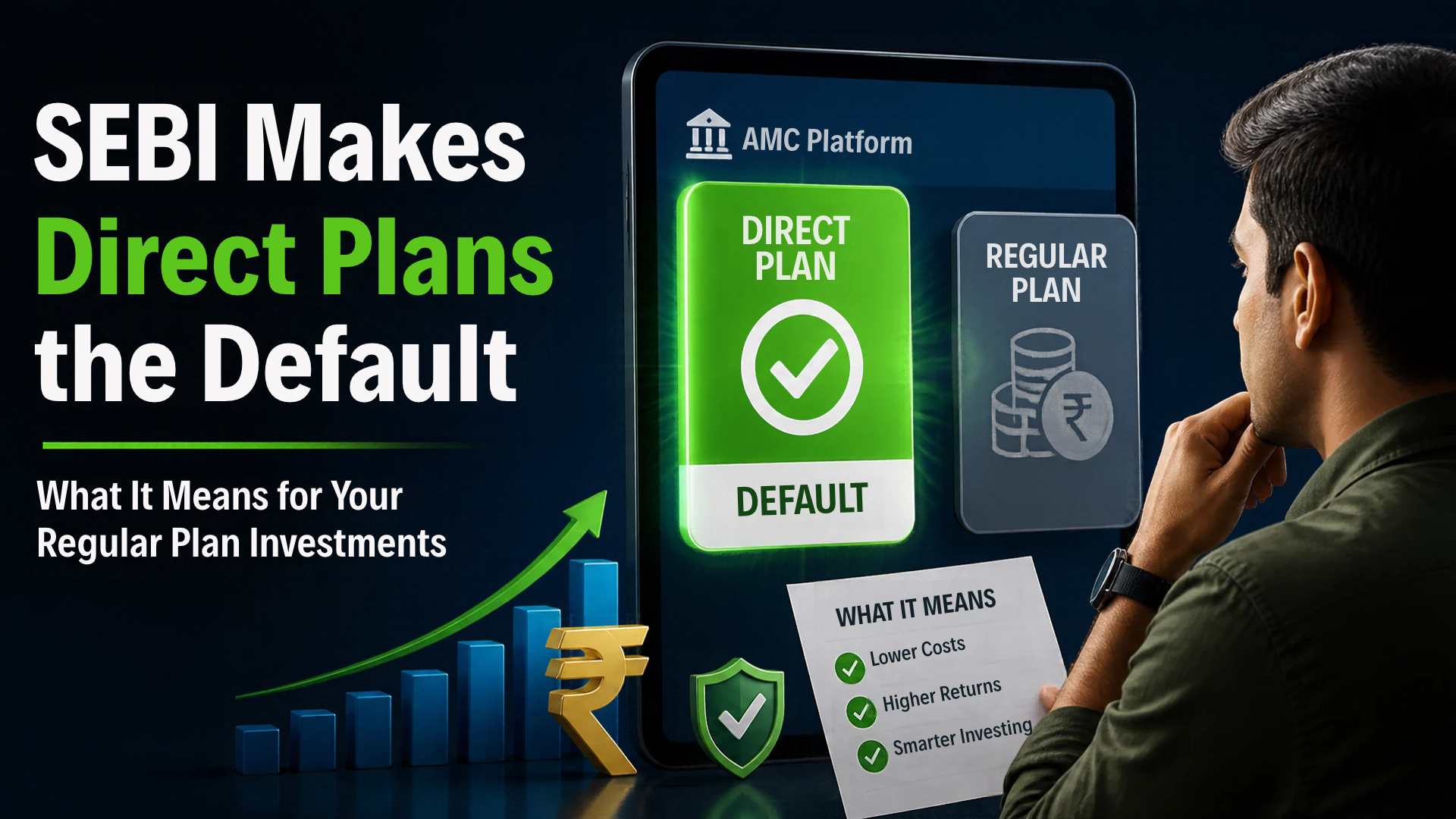
If you actively follow Indian financial news, you have likely seen headlines regarding the latest mandate from the Securities and Exchange Board of India (SEBI). The regulator recently announced that effective November 1, 2026, there is a fundamental shift in how mutual funds are presented online. Specifically, the SEBI direct plan default rule requires that when investors visit the digital platforms of Asset Management Companies (AMCs), the "Direct Plan" must be pre-selected as the default option.
For retail investors who have spent years building their wealth through regular mutual fund plans, regulatory headlines can often cause immediate anxiety. You might be wondering, "Are my investments being automatically converted?" or "Did my costs just change overnight?"
Transparency and clarity are the cornerstones of a successful wealth creation journey. In this detailed guide, we will unpack the exact scope of the SEBI direct plan rule November 2026, clearly explain the regular plan vs direct plan mechanics, answer the crucial "will my SIP change direct plan default" question, and provide an objective framework to help you evaluate if managing your wealth entirely on your own is the right long-term choice.
(If you come across unfamiliar financial terms like NAV, TER, or exit load while reading, we recommend keeping our comprehensive mutual fund jargon buster open as a quick reference).
Unpacking the Mandate: What Exactly Changed?
To understand the impact of the direct plan default AMC platform announcement, you must look at the specific scope of the SEBI mandate.
Historically, when investors visited an AMC’s own website or mobile app to make an investment without a distributor's code, some platforms retained a legacy interface where the "Regular Plan" was pre-selected in drop-down menus. SEBI recognized that if an investor is navigating an AMC's site entirely independently—without the assistance of a distributor—defaulting them to a regular plan created an unnecessary cost friction.
Here is what the new rule enforces:
- The Default Setting: On digital platforms owned directly by AMCs, the Direct Plan will now be the default selection for new investments.
- The SEBI Regular Plan Expense Ratio Disclosure: If an investor actively clicks the drop-down menu on an AMC website and switches their selection to a Regular Plan, the platform must immediately display a clear disclosure informing the investor that the Regular Plan carries a higher expense ratio due to distributor commissions.
This move is entirely about digital transparency at the point of purchase on manufacturer-owned platforms. It ensures every DIY (Do-It-Yourself) investor explicitly understands the cost implications of their selection.
Are Regular Plans Being Discontinued?
Absolutely not. This is a common misconception following the announcement. Are regular plans being discontinued? No.
Both Direct and Regular plans are permanent, legally mandated fixtures of the Indian mutual fund industry. The SEBI mandate simply changes which button is pre-clicked on AMC websites. Regular plans remain fully accessible and are actively chosen by millions of investors who rely on professional mutual fund distributors for ongoing portfolio guidance.
The Most Pressing Question: Will My Existing Investments Change?
Whenever regulations shift, the immediate concern is the safety and structure of existing portfolios.
Does the direct plan default apply to existing SIP mandates? The definitive answer is no.
If you have an ongoing Systematic Investment Plan (SIP) in a regular plan, or if you hold a lump-sum investment in a regular folio, the SEBI announcement does not alter your holdings in any way. There is no automatic conversion, no forced migration, and no interruption to your automated bank deductions managed via NACH (National Automated Clearing House).
Your current wealth creation engine remains perfectly intact. If you want a refresher on the mechanics of your existing automated investments, you can review our foundational guide on how systematic investment plans (SIPs) work.
Regular Plan vs Direct Plan: The Cost and Value Equation
To make informed decisions about your portfolio, you must objectively understand the regular plan vs direct plan framework. Both plans invest in the exact same underlying stocks or bonds, they are managed by the exact same fund manager, and they follow identical SEBI asset allocation rules. The only difference is the cost and the accompanying service.
The Direct Plan Mechanism
When you invest in a Direct plan, you transact straight with the AMC. Because no intermediary is involved, no distribution commission is paid. Therefore, the Total Expense Ratio (TER) is lower, which translates to a slightly higher Net Asset Value (NAV) over time.
Regular Plan Commission Explained
In a Regular plan, you invest through an AMFI-registered mutual fund distributor. The AMC pays a small, highly regulated trail commission to the distributor as long as you hold the investment. This is why the regular plan commission explained simply translates to a slightly higher TER compared to the direct plan.
It is crucial to understand that costs compound just like returns do. Over a 20-year horizon, the lower expense ratio of a direct plan will mathematically generate a larger gross corpus, assuming you hold the exact same fund with the exact same discipline. We break down the absolute mathematics of these fees in our detailed analysis of the impact of investment charges and platform fees on long-term wealth creation.
The Hidden Cost of DIY: Is Direct Plan Better for Beginners?
If direct plans mathematically generate slightly higher returns due to lower fees, is direct plan better for beginners?
The answer depends entirely on your financial expertise, your emotional discipline, and the time you have to manage your wealth. While direct plans save you a fraction of a percent in fees, they require you to act as your own financial advisor.
When you choose the DIY route, you take on 100% of the responsibility for:
- Fund Selection: You must research and compare thousands of schemes alone. (For context on what this entails, review our how to compare mutual funds checklist).
- Portfolio Review & Rebalancing: You must independently decide when to shift assets from equity to debt. (See our year-end mutual fund portfolio review checklist to understand this workload).
- Handling Underperformance: When a fund lags, you must analytically determine if it is a temporary market cycle or a fundamental failure. (We cover this complex evaluation in how to handle underperforming funds in your portfolio).
- Emotional Anchoring: This is the most expensive variable. During a severe market crash, DIY investors frequently panic and sell at the bottom because they have no professional to reassure them.
The "behavior gap"—the difference between the return a mutual fund generates and the actual return the investor takes home due to emotional buying and selling—often costs investors far more than the 0.5% to 1% they save on the expense ratio. We explore these destructive emotional traps in why your SIP is not growing: 7 mistakes Indian investors make and the psychology of investing and staying calm during market volatility.
Should I Switch From Regular to Direct Plan?
If you are a seasoned investor who possesses the time, market knowledge, and emotional fortitude to manage a complex portfolio independently, direct plans are structurally efficient.
However, if you are asking "should I switch from regular to direct plan," you must calculate the immense friction costs involved in transitioning an existing portfolio. Moving from a regular plan to a direct plan is not an administrative label change. According to the Income Tax Act, it is legally treated as a full redemption (sale) of your regular units and a fresh purchase of direct units.
Understanding the Switching Costs
- Switching Regular to Direct Plan Tax: Selling your existing units triggers Capital Gains Tax. If you have held equity units for less than 12 months, you owe 20% Short-Term Capital Gains (STCG) tax. If held for over 12 months, you owe 12.5% Long-Term Capital Gains (LTCG) tax on profits exceeding ₹1.25 Lakh. (You can track these holding periods via our mutual fund capital gains tax calendar).
- Exit Loads: If you switch units before the scheme's specified lock-in (often 12 months), the AMC will deduct an exit load, usually 1% of the value. You must check these penalties carefully, as outlined in our exit loads and lock-in periods mutual funds guide.
Before initiating any major portfolio restructuring, we strongly advise reading our structural guide on how to switch funds without losing tax benefits and consulting your Chartered Accountant.
The midfin360 Philosophy: Why Guided Wealth Creation Matters
At midfin360, we believe that transparency is vital. The SEBI mandate ensuring DIY investors see the cost difference on AMC platforms is a positive step for industry clarity.
However, we also know that for the vast majority of retail investors, navigating market volatility, deciphering tax laws, and maintaining decades of financial discipline is nearly impossible to do alone. This is exactly why midfin360 operates as an AMFI-registered mutual fund distributor (ARN-306591). (To understand the regulatory safeguards of this structure, read what is AMFI registered and why it matters).
We offer access exclusively to regular mutual fund plans because we provide the indispensable value of ongoing relationship management. When you invest through our platform, the slightly higher expense ratio of the regular plan pays for your dedicated Relationship Manager. We help you map your goals, conduct your year-end reviews, and act as your emotional anchor during market crashes—ensuring your portfolio remains focused on generating high, real returns that outpace the rising cost of living, a dynamic we explore in can mutual funds beat inflation?.
Conclusion
The SEBI direct plan default rule on AMC platforms is a welcome regulatory update that enhances cost transparency for DIY investors. However, it is crucial to recognize that this change does not alter the fundamental value proposition of professional financial guidance.
While saving on expense ratios is mathematically appealing, successful wealth creation is rarely defeated by a 0.5% fee; it is usually defeated by poor fund selection, improper asset allocation, and panic selling during market corrections. When evaluating the regular plan vs direct plan debate, you must honestly assess your own financial expertise and emotional discipline. If you value having an expert by your side to navigate complex tax laws, rebalance your portfolio, and keep your long-term goals on track, the structured guidance of a regular plan remains unparalleled.
Ready to build a resilient, expertly guided portfolio without the stress of managing it all alone?
Frequently Asked Questions
Manage all from your mobile
Take charge of your finances seamlessly — only on the Midfin360 app